Sen-sen-no-sen (先先の先) — Anticipatory Initiative
· by Roger Vickerman Renshi (7th Dan) · Principles
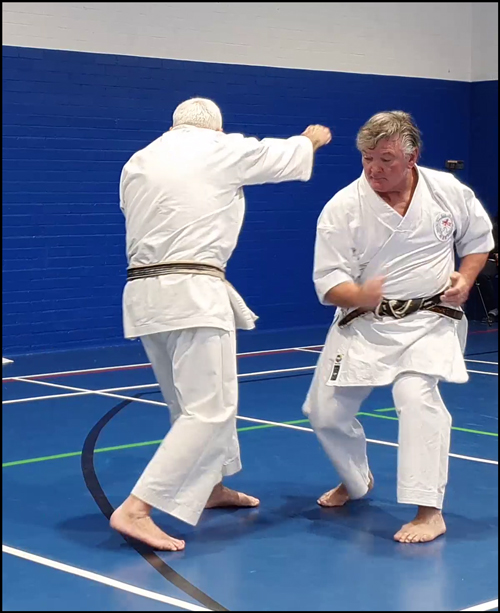
Sen-sen-no-sen (先先の先) is often translated as “initiative before the initiative.” It describes acting before the opponent’s attack has physically begun, based on the ability to perceive intention and recognise the moment when the opponent is preparing to move.
In Wadō-Ryū Karate, this represents the highest level of timing. Rather than responding after an attack or intercepting it as it begins, the practitioner recognises the opponent’s intention and moves before the attack can even start.
To an observer this can appear almost effortless, as if the defender somehow moved first without warning. In reality, the movement arises from awareness, distance control, and the ability to read subtle cues in the opponent’s posture, breathing, and focus.
Understanding the Meaning of Sen-sen-no-sen
The phrase consists of four elements:
- Sen (先) — initiative
- Sen (先) — initiative again
- No (の) — possessive connector
- Sen (先) — initiative
Together they describe taking initiative before the opponent can initiate their own action.
The practitioner perceives the opponent’s intention and enters before the attack becomes visible.
Perceiving Intention
Every physical movement begins with intention. Before an attack appears externally, the body begins to prepare:
- a subtle shift in weight
- a change in posture
- a tightening of the shoulders
- a focus of the eyes
Experienced practitioners learn to recognise these early signals. When the intention becomes clear, movement occurs immediately.
Because the attack has not yet begun, the opponent is often unable to adjust or defend effectively.
Sen-sen-no-sen in Wadō Strategy
Wadō-Ryū emphasises positioning, timing, and efficiency rather than direct collision. Sen-sen-no-sen reflects this strategic mindset.
Instead of waiting for the opponent’s attack to develop, the practitioner recognises the emerging opportunity and takes control of the exchange before it begins.
This often involves:
- entering into superior position
- controlling distance (ma-ai)
- disrupting the opponent’s balance
- preventing the attack from developing
Examples in Wadō Training
Although Sen-sen-no-sen represents an advanced level of timing, its principles appear throughout Wadō training.
In kumite, experienced practitioners often move just as the opponent prepares to attack, preventing the attack from fully forming.
In Kihon Kumite, the structure of the exercises trains sensitivity to distance and timing, helping practitioners recognise the moment before an attack becomes unavoidable.
In kata, certain movements can be interpreted as entering before the opponent’s attack develops, disrupting the attack before it can occur.
The Role of Distance (Ma-ai)
Correct distance is essential for Sen-sen-no-sen.
If distance is too great, the opponent can adjust before contact occurs.
If distance is too close, the practitioner may be forced to react instead of acting freely.
When distance is correct, the practitioner can recognise intention and move before the opponent’s technique becomes dangerous.
Sen-sen-no-sen and the Mind
Because Sen-sen-no-sen depends on perception rather than reaction, the mental state of the practitioner becomes extremely important.
The mind must remain calm, aware, and free from unnecessary tension.
This state is closely related to Wadō concepts such as Mushin and Fudōshin.
When the mind is clear and observant, intention becomes easier to recognise.
Sen-sen-no-sen Compared with Other Timing Concepts
Traditional budō often describes three main timing strategies:
- Go-no-sen — responding after the attack begins
- Sen-no-sen — entering at the same moment the attack begins
- Sen-sen-no-sen — anticipating the attack before it begins
Among these, Sen-sen-no-sen represents the most subtle form of initiative, relying heavily on awareness, distance, and experience.
In Simple Terms
Sen-sen-no-sen means recognising the opponent’s intention and acting before the attack begins.
Rather than reacting to movement, the practitioner responds to intention itself. Through awareness, positioning, and timing, the exchange is controlled before the opponent’s technique can even start.