Traditional Karate
Monthly Newsletter • 1 November 2026 • Issue 30
Monthly Update from Wadō-Ryū Benkyō
Hello,
Welcome to your 30th monthly update from Wadō-Ryū Benkyō.
This month we look for the fundamentals within Wanshū, continue our Kumite Kata series with No.6 in full, explore Noru — riding the opponent’s movement — and feature an interview with Arthur Meek Sensei.
🥋 1. Saturday Benkyō — Looking for Kihon in Kata: Wanshū
Over the last few Saturday Benkyō sessions, we have been dusting off some of the lesser-seen kata. That is not to say we do not practise them, but some come around less frequently in the cycle than others. One of my favourites, and one we return to whenever we can, is Wanshū.
I do not remember spending much time on Wanshū with instructors other than Toru, but it has stayed with me all these years. It is a dynamic and remarkably complete kata. Recently, having filmed the fourth volume of our Kihon Fundamentals series, it struck me just how many of the things we had been exploring in those lessons can be found within Wanshū.
Some instructors and clubs regard Wanshū as an ‘advanced’ kata. Personally, I tend to think that all kata are simply kata. Some are introduced later so students are not overloaded while they are still finding their way through the Pinan kata and Kūshankū. Yet so much of what we learn as kyū grades can be found in Wanshū. For that reason, I like students to encounter it relatively early, even if they are not expected to know it in depth. If it appears on a course, it is not completely unfamiliar; and when the time comes to study it properly, the pattern is already there. I cannot recall seeing it in a grading syllabus myself, although it remains a popular choice in kata competition.
Today, rather than giving a complete breakdown of Wanshū, I want to look at a handful of places where the fundamentals are hiding in plain sight. We filmed a full kata breakdown some years ago, linked below. The latest Kihon Fundamentals Volume IV video is also featured in this month's video section.
Dropping and Punching — Both Hands Have a Job
Right from the opening, Wanshū gives us dropping and punching. But watch the rear hand: it is not dead, nor is it simply pulled away for appearance. It works with the front hand as an uke, using meotode — paired hands — to slip the incoming attack while allowing the front hand to connect cleanly. Defence and attack belong to the same movement. If we only see a punch, we miss half the lesson.
The Back Foot — Spring, Stability and Direction
As the kata progresses beyond the opening sequence — through empi and nami-zuki chūdan-uke — we push forward into gedan-barai and a jōdan gyaku-zuki combination. Here, I want you to pay particular attention to the back foot. It helps us create the spring, speed and power needed for the next action.
Before the backward movement, the rear foot draws up beneath us, preparing the body to spring back and establish a stable base for the gedan-uke. It is easy to concentrate on the arms and miss how much work is being done by the legs.
Wanshū also provides a wonderful opportunity to study mawatte: using body weight and coordinated turning to change direction rapidly while performing the next technique. Through the three quick changes of direction, we can see a practical expression of dōjini — actions occurring together, rather than one after another.
Crane Stance and Kake-uke — Timing Is Everything
After those rapid turns, we face the front and draw up into a crane-like position, centring our weight over the supporting leg. From there, we move off the attacking line, dropping to the right as we perform kake-uke.
We encounter kake-uke elsewhere, including Pinan Yondan, Bassai and Jion. What makes this example interesting is that we are not adopting the familiar angled, cat-stance presentation; we are facing Uke more directly. The timing must therefore be precise. If we simply stand in front of the attack and attempt to catch it with the arm, we leave a very inviting target. The protection comes from moving off the line as the receiving action takes place.
Three Shuto — Three Different Possibilities
One of my favourite passages in Wanshū is the sequence of three shuto actions. They may look similar at first glance, but each has a different quality, opening up a whole world of possibilities for shuto-uke and shuto-uchi.
The first can be read defensively, perhaps receiving a jōdan-zuki. The second includes a small half-step backwards before we move forward again. That adjustment is important: it tells us that ma-ai is changing. Perhaps Uke has stepped in or continued to press forward, and we must first recover the right distance before entering.
That second shuto could just as readily be understood as shuto-uchi — a decisive strike towards the neck, collarbone or jawline. As we explored in Kihon Fundamentals, the back foot and the body create the power line; the hand is only its final expression. Correctly coordinated, this action can change who controls the exchange.
Then the kata changes again. We shift dynamically, using the front foot to support the gyaku-zuki before following through with the third shuto. It is a wonderful sequence and a joy to practise. Rather than seeing three repetitions of the same movement, try asking what has changed in distance, angle and intention each time.
Yama-zuki — Junzuki no Tsukkomi Hiding in Plain Sight
Towards the end of Wanshū, we drop forward into yama-zuki. This is often described as a double punch, although I prefer to explore it as an uke and punch working together.
You might think that we did not cover yama-zuki in the latest Kihon Fundamentals video. But look again at the back foot. The underlying mechanics are remarkably familiar: the same drive, timing and support we develop in junzuki no tsukkomi are there to be used here. If we have learned how the back leg contributes to speed and power in kihon, why would we abandon it when practising kata?
Kihon Means Foundation — Not Something We Leave Behind
For me, this is the beauty of kihon: it appears throughout Wadō-Ryū. Kihon is often translated as ‘basics’, but I think that translation can do it an injustice. Foundations is a much more useful way of understanding it. A foundation supports everything built above it. We do not graduate beyond it, nor do we ever finish improving it.
As our karate develops and we place more demands on those foundations, they need to be maintained, strengthened and refined. Wanshū reminds us that the work we do in a single kihon technique is never isolated from the kata or from paired practice. It is all the same karate.
So next time you are in the dojo, why not give Wanshū a run-through and see whether looking for the kihon changes how the kata feels?
Watch: Wanshū Kata Breakdown
Watch the Wanshū breakdown on YouTube🎥 2. Video of the Month — Kihon Fundamentals Volume IV
This month's Saturday Benkyō feature explores how the mechanics developed in our Kihon Fundamentals Volume IV series reappear in Wanshū, from shuto to the use of the back foot in generating speed, spring and power.
Watch Kihon Fundamentals Volume IV on YouTube📝 3. Kumite Kata No.6 — Roppon Me
Kumite Kata No.6 – Roppon Me
A study in simultaneous defence and attack, movement off the centre line, flowing counters, kuzushi and the natural drop of body weight
Kumite Kata No.6 – Roppon Me explores how a small change of position can turn defence into attack without interruption. Uke’s advancing Jōdan Zuki is met not by a static block but by Tori moving off the attacking line and flowing into a compact return strike.
the body must not stop moving. A circular arm action is useful only when it is connected to footwork, weight transfer and the displacement of Uke’s centre. The Kumite kata progresses through covering, Jōdan Uraken, kuzushi and Nagashi Shuto Uchi before withdrawing to distance.
Opening Kamae – Tate Seishan Dachi
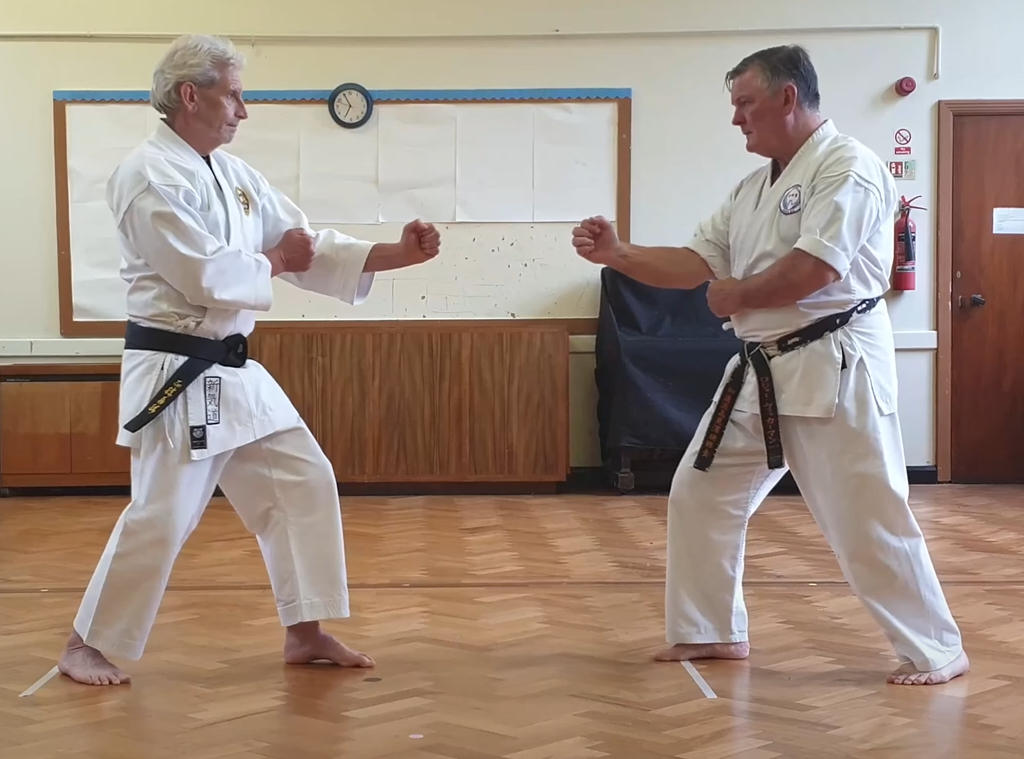
Uke begins in Hidari Tate Seishan Dachi, while Tori adopts Migi Tate Seishan Dachi. The opening distance allows Uke to commit to a head-level attack and Tori to respond by changing the line of the body. The distinction between their left and right stances matters: it establishes the relationship for the entry.
Uke Attacks – Okuri Ashi Jōdan Zuki
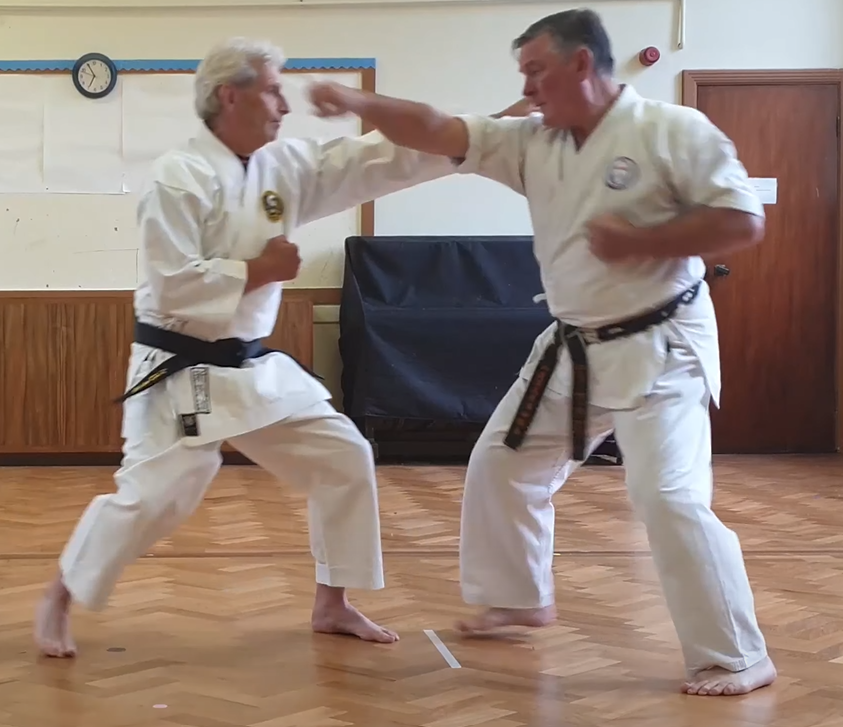
Uke advances with Okuri Ashi Jōdan Zuki. Tori responds with the action described in the breakdown as Jōdan Furo Zuki. defence and attack together: Tori must move away from the line of the punch while returning an action towards Uke’s eyes. This is not simply standing still and exchanging punches.
Covering the Attack – Move Off the Centre Line
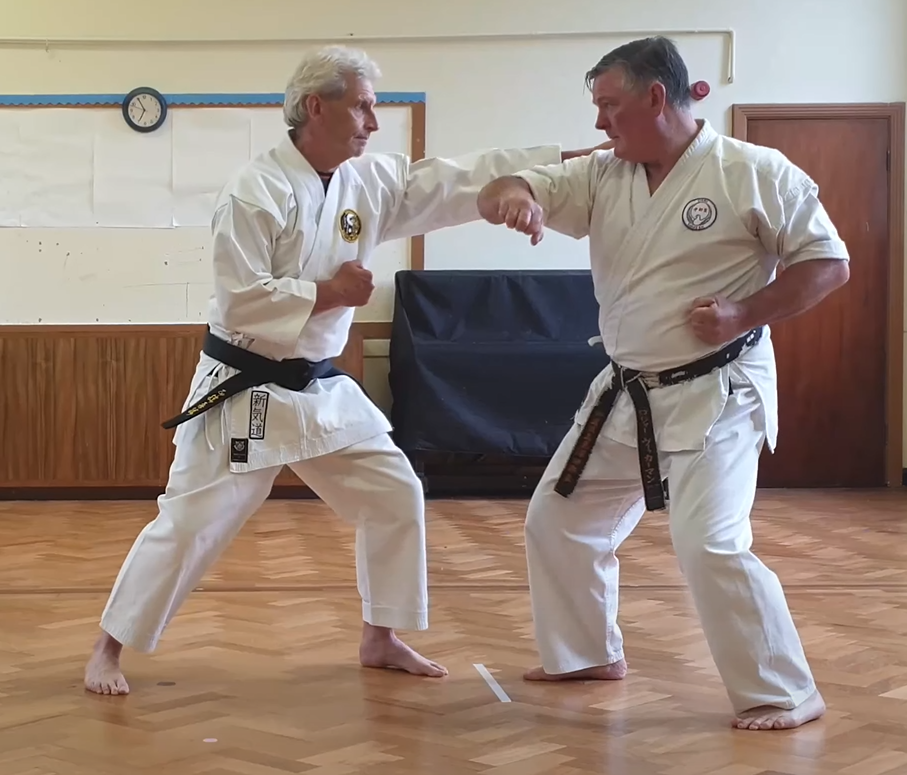
Tori covers the attacking arm and ensures the body has genuinely moved outside the line of the zuki. A small pull and adjustment of the feet matter: leaving the foot or body on the original attacking line gives Uke the opportunity to retract and attack again. Encourages Uke to check whether you can really escape the centre rather than merely retreating straight backwards.
Entering with Jōdan Uraken
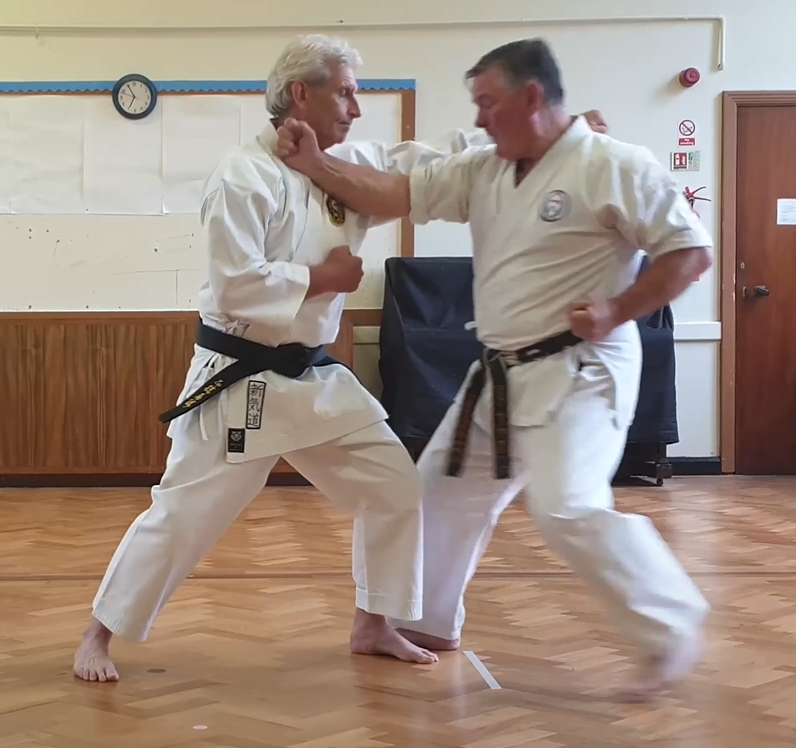
Tori moves in with Jōdan Uraken, directed towards the head. The initial circular return should be compact. It can be exaggerated during early study to make its pathway clear, but that extra motion should gradually disappear. The arm does not make a separate strike after the feet have finished: the body flows into the return.
Kuzushi – Arm and Knee Position
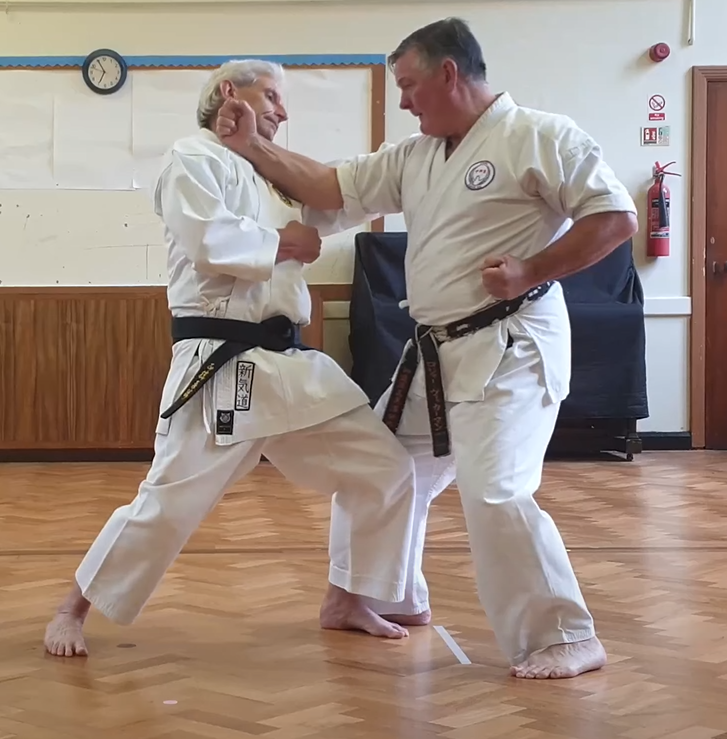
Tori uses the arm and knee position to disturb Uke’s balance. The effect is more than contact at the head: the relative placement of the bodies turns and displaces Uke, placing pressure through the posture and spine. Uke should be feeling slightly twisted and taken backwards, rather than merely being pushed in a straight line.
Nagashi Shuto Uchi – Flowing into Control
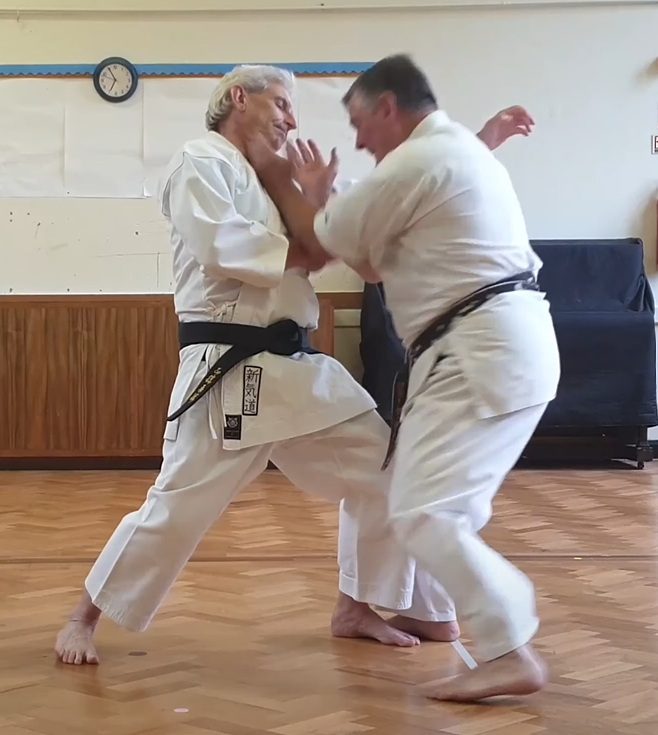
Tori follows with Nagashi Shuto Uchi, bringing the right arm across Uke’s body to take control. The demonstration stresses Ryūsui — flowing like water. The return strike should feel heavy because the moving body contributes its weight. The final downward action is a gentle drop of body weight, not a muscular shove with the arms. Tori should keep moving through the technique rather than dividing it into rigid counts.
Withdrawal – Sugi Ashi Kōtai
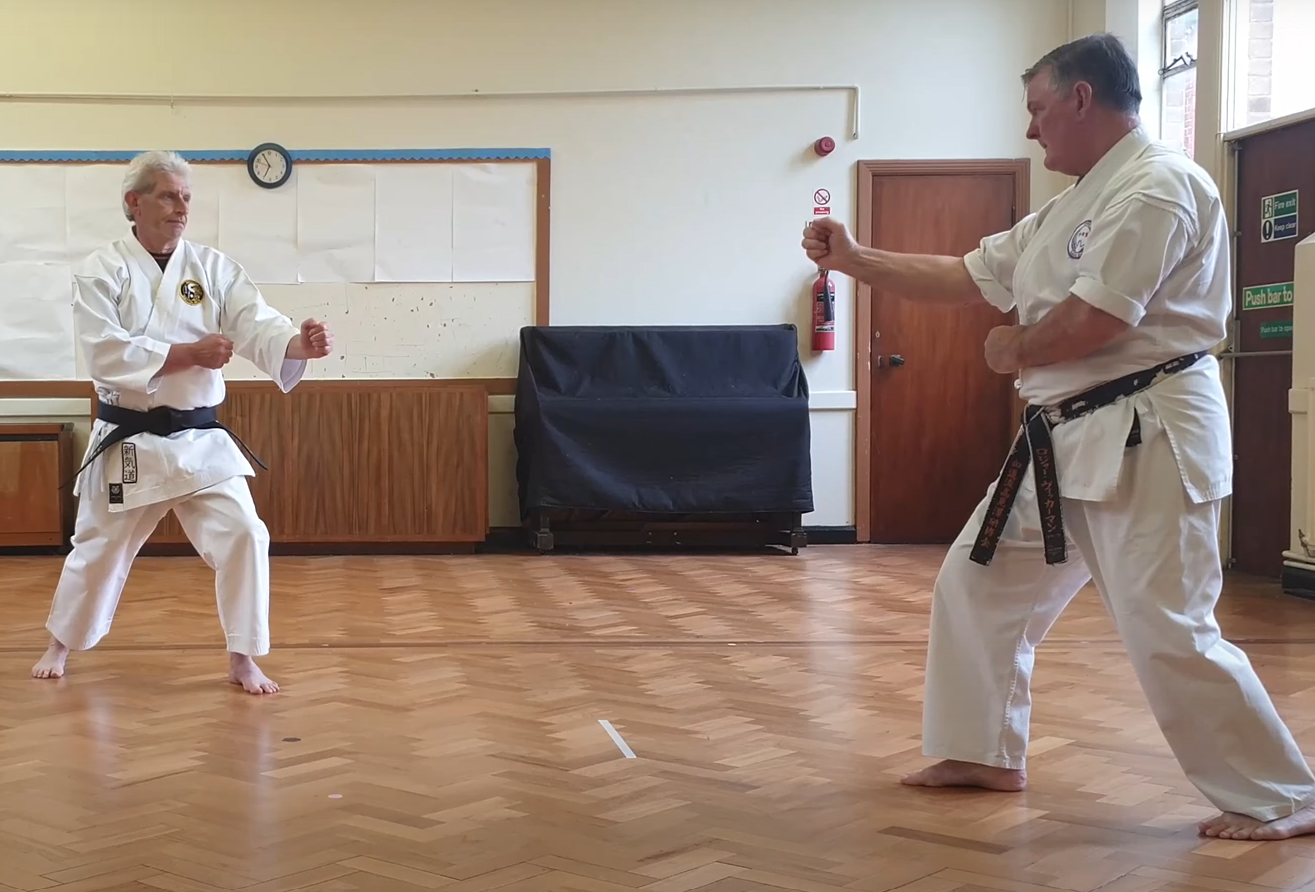
After completing the exchange, the practitioners separate with Sugi Ashi Kōtai into Gyaku Hanmi Gamae. The distance created is significant: when the preceding movement has properly displaced Uke, Uke may find themselves much further from their original attacking line than expected. Withdrawal is performed with posture and awareness, not as an afterthought.
Key Principles
- Defend and attack together: leave the attacking line as the return technique develops.
- Do not leave the foot behind: foot position must support the evasive body movement.
- Keep the circle small: exaggeration is a learning tool, not the finished movement.
- Ryūsui: let the counter flow rather than stopping between individual actions.
- Whole-body weight: the return and shuto should carry the body, not just the arm.
- Gentle sinking: allow weight to drop naturally instead of pushing down.
- Observe Uke’s centre: genuine kuzushi changes Uke’s alignment and recovery distance.
Common Errors
- Moving directly backwards while remaining on the line of attack.
- Leaving a foot in range as the upper body evades.
- Making the circular strike unnecessarily large.
- Performing the counter and entry as disconnected movements.
- Trying to force Uke down with an arm push rather than coordinated body weight.
- Finishing without observing whether Uke has actually lost balance.
Training Progression
- Line-of-attack drill: practise Uke’s Okuri Ashi Jōdan Zuki and Tori’s movement outside the punch without the follow-up.
- Cover and return: introduce the small circular return towards the head, with careful control and continuous footwork.
- Entry and kuzushi: explore how the arm and knee positions affect Uke’s posture without applying force to the neck.
- Flowing shuto: connect the return into Nagashi Shuto Uchi, using a natural lowering of weight.
- Complete sequence: connect attack, evasion, counter, kuzushi, shuto and withdrawal smoothly.
Final Thoughts
Roppon Me demonstrates that effective technique is not a collection of isolated arm movements. Tori first removes the body from danger, then lets the return action, entry and weight transfer become one continuous flow. The result should be felt in Uke’s balance, not simply seen in the shape of Tori’s hands.
The deeper lesson is to make the movement smaller, smoother and more natural while retaining its effect: move off the line, flow through the counter, and allow the body’s weight to do the work.
📅 4. News and Updates
There are no further courses planned for the remainder of 2026. Please keep an eye on our events page for future courses and updates.
✨ 5. Spotlight on the Wadō-Ryū Community
Arthur Meek Sensei, 8th Dan Renshi
This month’s spotlight features an interview with Arthur Meek Sensei, 8th Dan Renshi and Acting Chief Instructor of the Wadō-Ryū Karate-dō Academy. Published by Toronto Wado-Ryu Karate in September 2023, the interview is with Domenico Capilongo and was conducted by Ali Mirkarimi.
Meek Sensei reflects on his early karate years in Bridgwater, where he first watched training from the sidelines before eventually being allowed to join. He recalls the demanding nature of the training and the determination that carried him through to Shodan.
A particularly memorable part of the interview concerns his nine months training at Nihon University (Nichi-Dai) in Japan. Rather than describing a secret technique as the lasting lesson, he emphasises spirit, perseverance and the mental resilience required to continue through extremely demanding training.
He also discusses the adaptability of Wadō-Ryū across boxing, kickboxing, MMA and grappling, and how these experiences deepened his understanding of relaxation. His reflections on datsuryoku and jūryoku connect relaxed movement, gravity and effective use of body weight, drawing on the influence of Shiomitsu Sensei.
The interview also explores the Academy’s shared commitment to carrying forward Shiomitsu Sensei’s teaching and legacy. It is a thoughtful read about training, responsibility and the continuing study of Wadō-Ryū.
Read the full Arthur Meek Sensei interview (PDF)🧠 6. Principle of the Month — Noru (乗る)
In Wadō-Ryū, noru means to ride: to connect with an opponent’s movement and use that relationship to guide, influence or control what happens next. Rather than meeting force with force, we learn to travel with it — without surrendering our own balance, structure or intention.
At first, riding might sound passive, as though we simply allow ourselves to be carried along. Yet the opposite is true. Effective noru requires us to be in command of our own centre. Only then can we enter, yield, apply pressure or change direction without being pulled out of position by the opponent.
What Noru Means in Wadō-Ryū
Imagine placing your hand against something already moving. If you stiffen and resist, you create a collision. If you collapse, you lose control. Noru offers a third possibility: maintain a living connection, match the movement just enough, and use your position and body weight to change the relationship in your favour.
It is not merely following. The purpose is to remain free to act while the opponent becomes increasingly constrained. Contact may be brief, but it should give us information about direction, commitment, pressure and balance.
Core Characteristics of Noru
1) Control of Our Own Centre
Before we can ride the opponent, we must be able to move ourselves. If our weight falls outside our base, if our shoulders lead independently of our hips, or if we lean into the opponent, our apparent control becomes dependence. The opponent can then move us as easily as we hope to move them.
In noru, our centre travels deliberately. The feet, hips and upper body support the same action, allowing weight to be added or withdrawn without losing the ability to change direction. We are not simply heavy: we are appropriately weighted, at the right place and moment.
2) Connection Without Stiffness
Contact with an arm or body does not mean gripping, pushing continuously or locking our muscles. Unnecessary tension makes us slow to respond. A light but meaningful connection can tell us where the opponent is going and allow us to accompany or influence that movement.
3) Riding Rather Than Colliding
The most obvious mistake is to treat an incoming attack as a contest of strength. Noru asks whether we can take a different line, travel with the force, or settle our weight through the contact so that the attack no longer has the effect intended.
4) Defence and Attack Become One
When the movement is correctly timed, the same body action that protects us can place the opponent under pressure. We do not necessarily block first and then decide to counter. We may defend, enter and unbalance within a single connected movement — an expression of kōbō-ittai.
Noru in Kumite Gata No.10 — Riding Over the Chūdan Zuki
Kumite Gata No.10 gives us a particularly clear example. Uke advances with okuri ashi chūdan zuki. Rather than attempting to stop the punch head-on, Tori changes the line of engagement and rides over the attacking arm while delivering gedan zuki. The initial receiving action and counter are not separate, disconnected tasks.
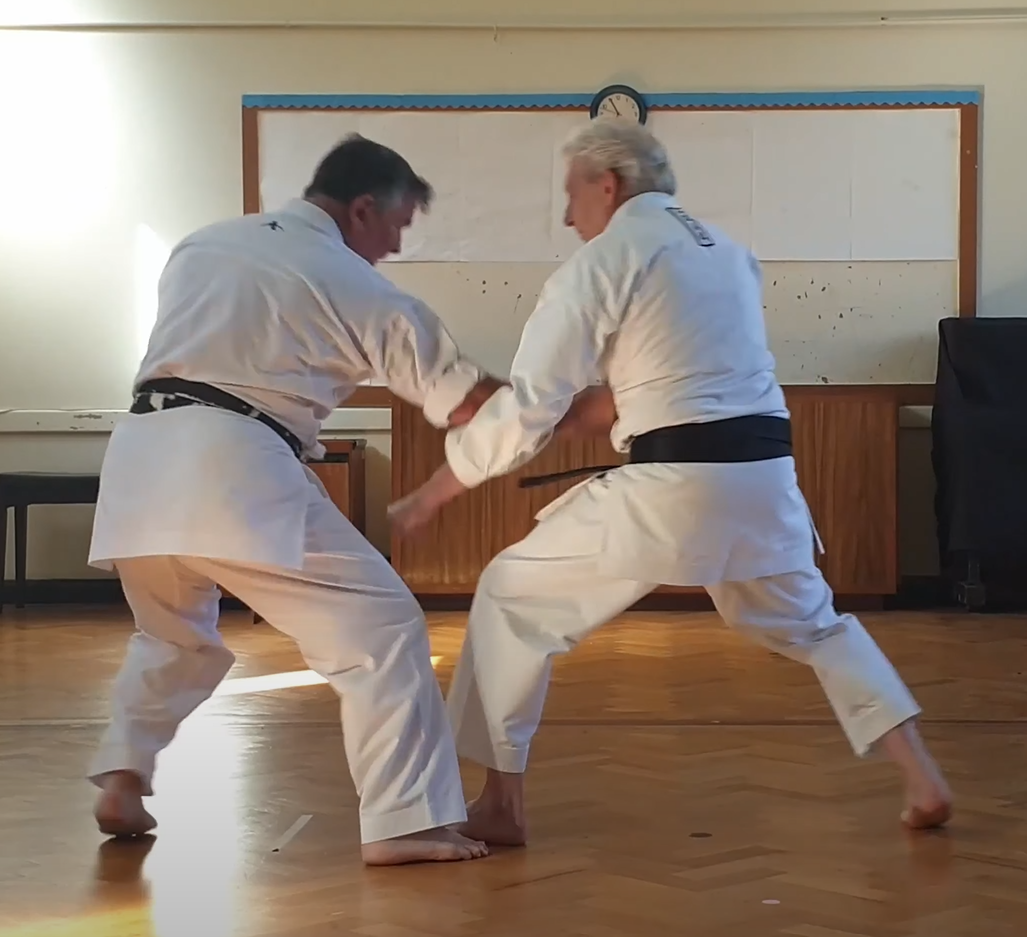
There is a subtle but important nagashi here. By changing the angle of entry, we avoid meeting the full force of the punch along its strongest line. The arm is guided or allowed to continue as our body occupies a more advantageous position. The adjustment may be small, but the effect on the relationship between the two bodies can be considerable.
This also demonstrates irimi — entering. Irimi does not mean rushing blindly towards danger. It means entering at an angle and time that reduce the opponent’s ability to use their attack while improving our own position. Noru and irimi work together: we ride the committed action as we move into a place from which we can act.
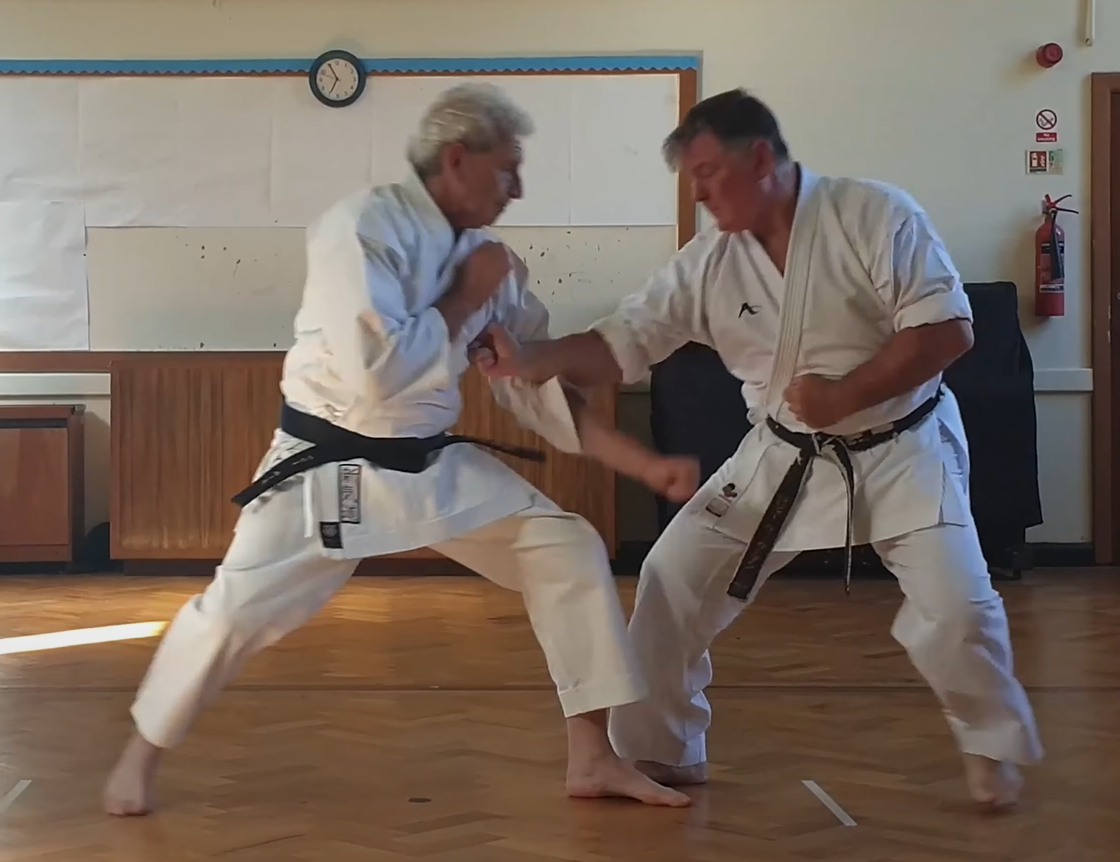
As the sequence continues, Tori advances with jōdan migi haito uchi and hidari gyaku zuki, dropping to cover Uke’s free arm with the left hand. Here the lowering of the centre is not an isolated dip or an attempt to force the opponent down with arm strength. The whole body settles into the action, giving the contact direction and substance.
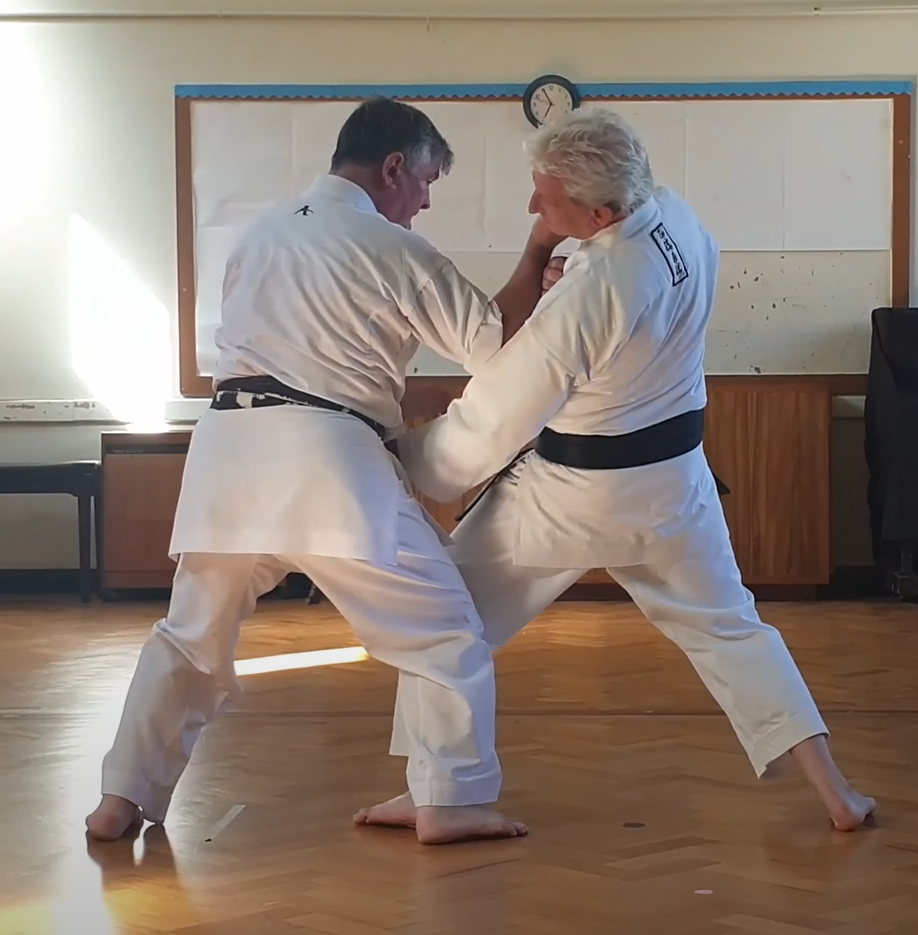
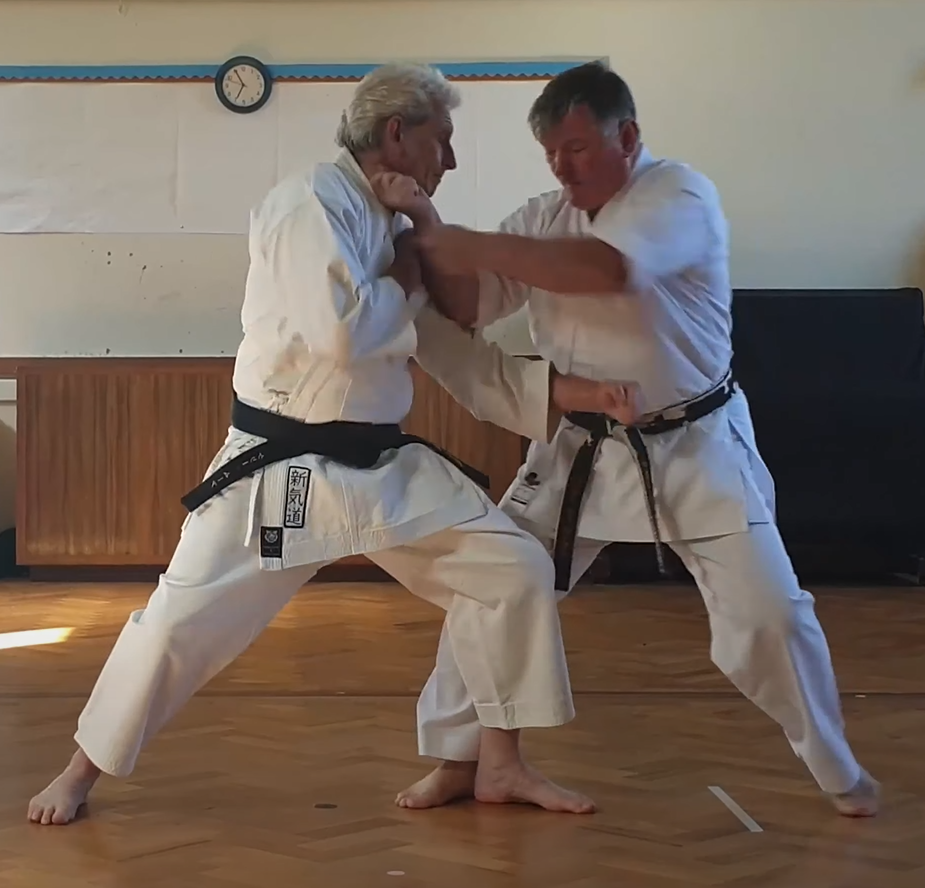
It is here that kuzushi becomes especially apparent. When we ride the movement and alter the opponent’s structure, their balance is affected not simply by the amount of force we apply, but by where, when and in which direction we apply it. The entry, redirection and settling of weight contribute to the same outcome.
What looks like a powerful downward action should therefore be understood as a coordinated use of the centre, angle and timing — not as a brute-force struggle between two arms.
Noru in Kihon Kumite No.6 — Riding Away With the Sokuto Geri
In Kihon Kumite No.6, we can explore noru from another direction. As Uke commits to sokuto geri, Tori does not need to meet the kick with an immovable barrier. Instead, the body can draw back and travel with the incoming pressure, maintaining a compact shape and a protective relationship to the attack.
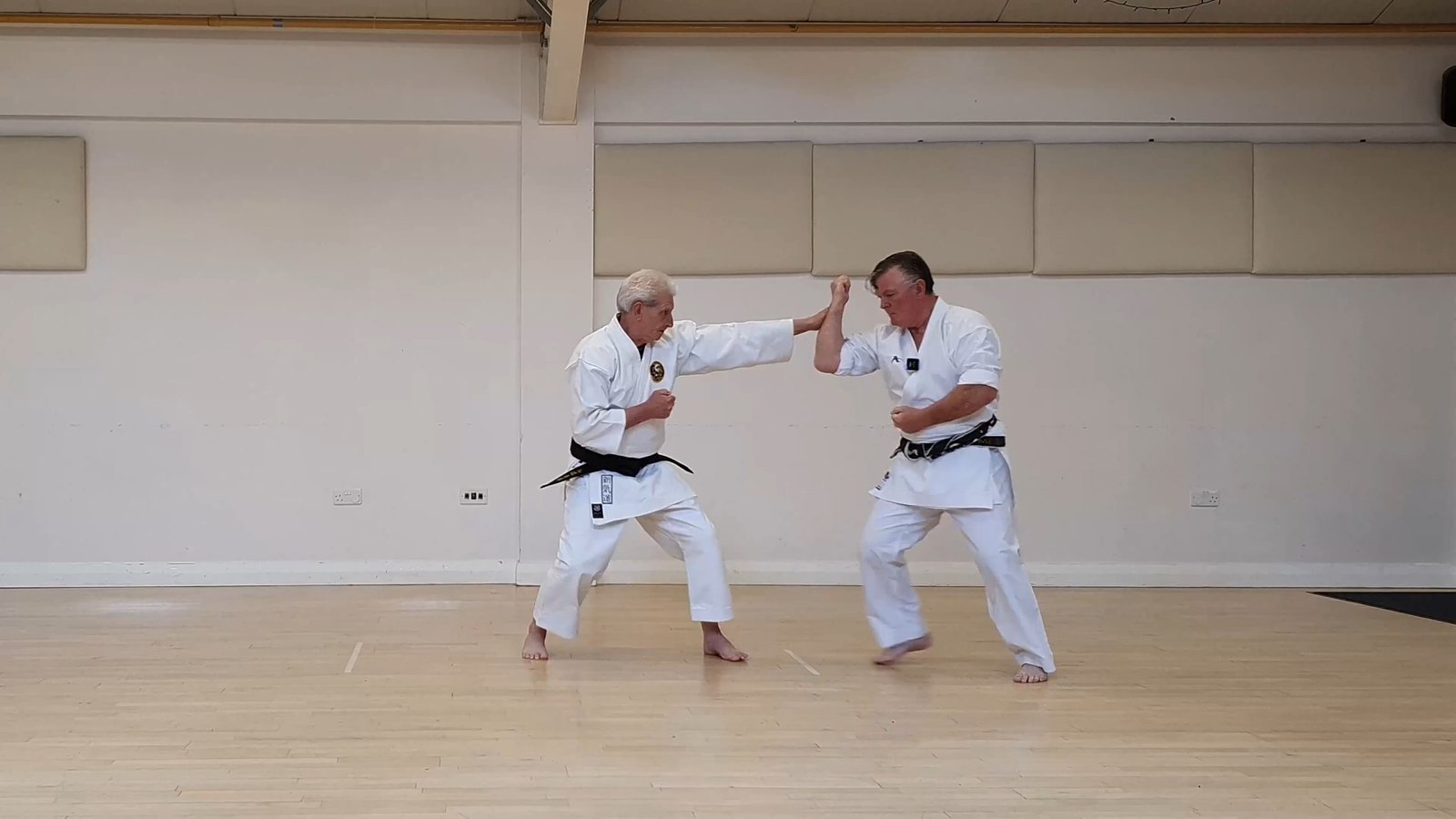
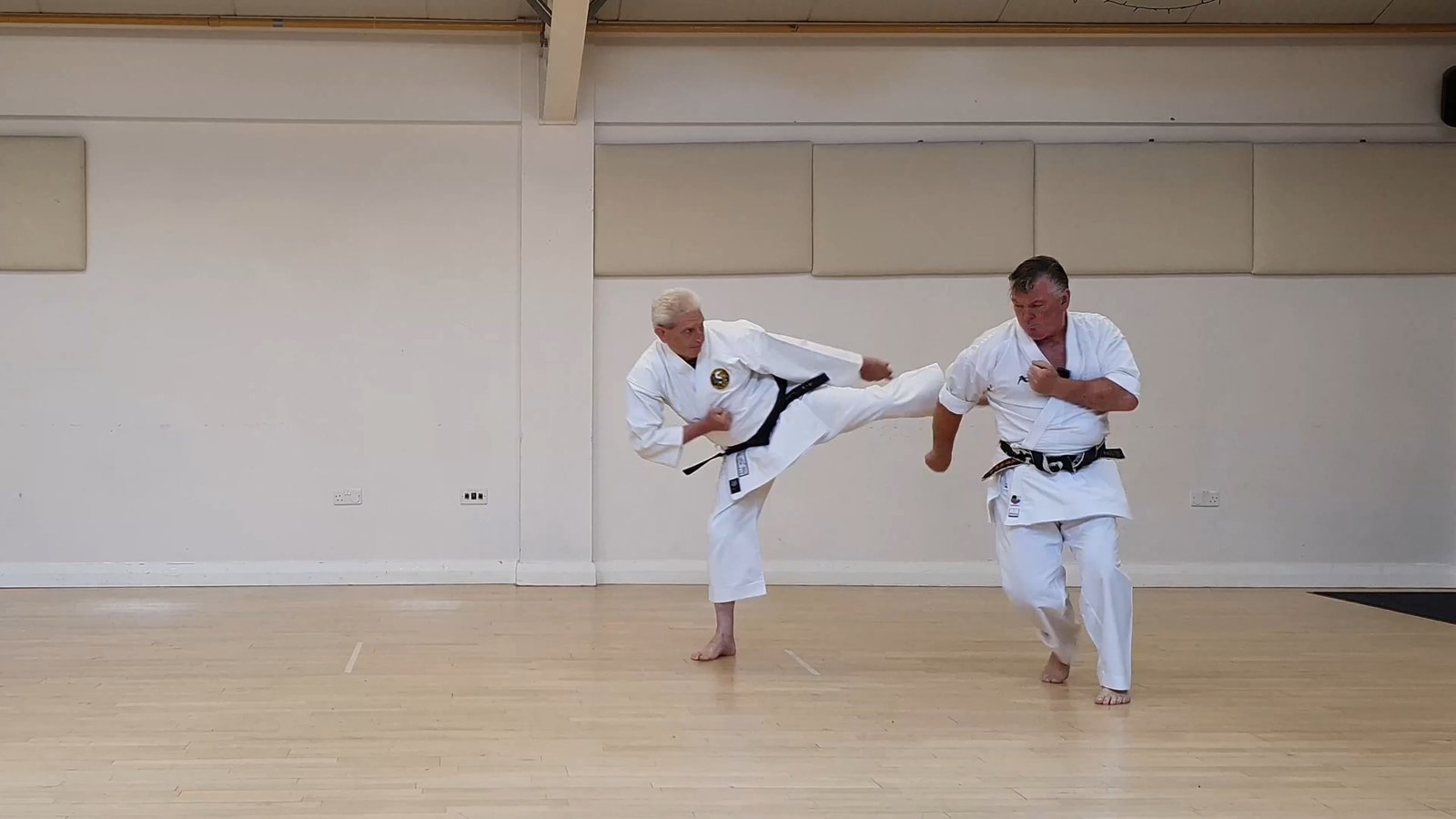
Although the outward movement differs from the entering action in Kumite Gata No.10, the underlying principle is the same. We do not become rigid at the moment of contact. We allow the opponent’s commitment to inform our movement, adjusting our distance and posture without losing our ability to respond.
Noru and Other Wadō Principles
- Irimi — entering on a safer, more useful line while the opponent is committed.
- Nagashi — subtly changing the line of contact so the attack is not met by direct collision.
- Kuzushi — using that connection and changed relationship to disturb the opponent’s balance.
- Datsuryoku — releasing unnecessary tension so we can sense and adapt to movement.
- Shizumu and omomi — settling the centre and applying meaningful body weight without leaning or collapsing.
- Kōbō-ittai — defence and attack emerging together rather than as two separate actions.
These principles are not boxes to be ticked one after another. In good practice they overlap. A small change of angle can be nagashi; moving into the resulting opening is irimi; keeping contact as we settle our weight is noru; and the effect upon the opponent is kuzushi.
Questions to Explore in the Dōjō
- Can I stay connected without pushing or pulling with my arms?
- Can I change the angle of entry without losing the ability to strike?
- When I lower my centre, does my whole body support the action, or am I merely bending at the waist?
- Can I move with the kick in Kihon Kumite No.6 without being driven backwards out of balance?
- Can my partner feel the difference between a hard collision and a controlled, connected ride?
To ride the opponent’s movement, we must first be able to govern our own.
In Simple Terms
Noru is the ability to connect with an opponent’s movement and use it without being controlled by it. Whether we enter over a punch in Kumite Gata No.10 or travel with a kick in Kihon Kumite No.6, the lesson is the same: our centre remains our own, even as we use the opponent’s movement to shape the encounter.
🙏 Thank You for Being Part of the Community
If you have any questions, video requests, or feedback, simply contact us here - we read everything.
Wishing you a fantastic month of training,
Roger and The Team
Wado-Ryu Benkyō
https://wadoryubenkyo.co.uk/